This includes the composition of the sector, the key characteristics of public entities, the accountability framework within which public entities operate and the framework for determining each individual entity’s operational priorities and constraints.
The Victorian public sector performs a wide variety of functions on behalf of government, including direct provision of services to the community, provision of policy advice, the collection and administration of public money and, regulating funding and contracting private and non-government organisations for service delivery. These services are delivered through the Victorian Public Service: departments, authorities and offices, and the Victorian Public Sector Commission (VPSC); and through public entities operating in the wider public sector.
Public entities are organisations that exercise a public function but are established outside the public service. As bodies operating at ‘arm’s length’ from government, public entities perform their functions with a greater degree of independence from ministers in their day-to-day decisions.
A current summary of the Victorian public sector.
Public entities are a diverse group of organisations and undertake a wide range of advisory, service delivery, regulatory and other functions within the public sector. Victoria’s public entities include employing bodies such as hospitals, technical and further education (TAFE) institutions, police and emergency service organisations, and water and land management bodies. Also included are many public entities that do not employ staff, such as ministerial advisory committees.
Table 1 summarises the most common functions undertaken by public entities in Victoria. A public entity will often have hybrid or multiple functions.
Table 1: Common functions undertaken by public entities
Despite this diversity, public entities share a number of common characteristics. In general, public entities:
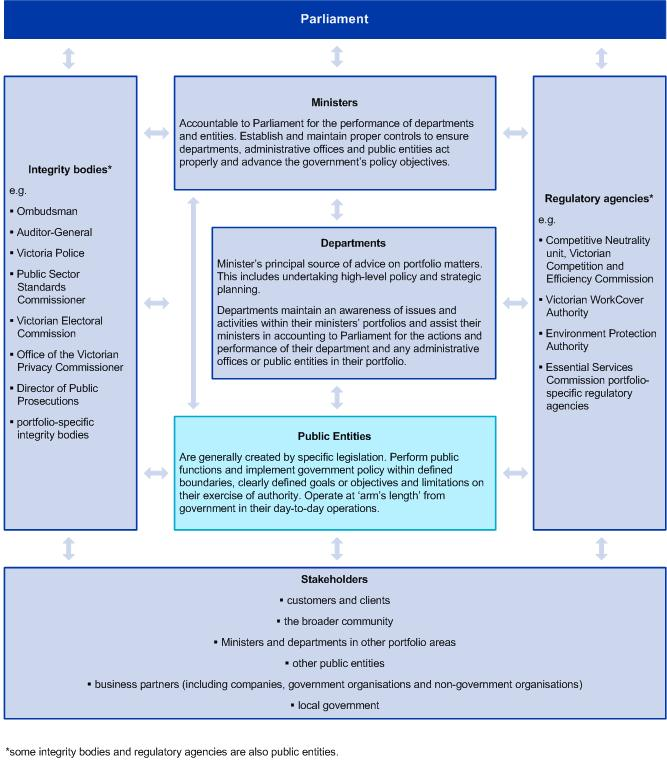
Although public entities operate at ‘arm’s length’ from government in their day-to-day operations, they operate within a broad accountability framework that ensures they are properly directed, controlled and held to account. The CEO of a public entity is accountable to the board of that entity. A public entity’s board is accountable to its responsible minister for the exercise of its functions. The responsible minister, in turn, is accountable to parliament and the community.
Public entities also have a working relationship with their minister’s portfolio department which, as the minister’s principal source of advice on matters within the portfolio, provides support to the minister to account to parliament and ensures the overall coordination of activities within the portfolio.
Figure 2 below shows the accountability framework and key relationships for public entities.
Public entities are established using a variety of legal forms. The legal form of a public entity refers to its status as an incorporated or unincorporated body and the manner in which it is created, whether that be through a legislative or a non-legislative process. In Victoria, public entities may be established using a number of legal forms, depending on factors such as the functions of the entity and the degree of ministerial control required.
With the exception of advisory councils, most public entities are created and empowered through an Act of parliament which is referred to as that entity’s enabling legislation. These entities are known as ‘statutory authorities’. Statutory authorities can be established under:
All Victorian public sector organisations are ultimately responsible to the Victorian people through their minister and the parliament, within a legislative framework that allows for the flexibility necessary to respond to change. On behalf of their board, CEOs ensure that their entity fulfils its role. Public entity boards and CEOs need to know who can direct them, how, and in what circumstances.
The operational priorities and constraints of individual public entities are largely determined by:
The enabling legislation is the principal reference document that specifies the purpose, responsibilities, powers, limitations and governance arrangements for the entity. It should be read in conjunction with other legislation and government policies.
The enabling legislation can also be read in conjunction with the second reading speech – the speech given when the legislation was introduced into parliament. This speech explains the general principles and purpose of the legislation and can offer insights into the intentions and reasons for the creation of the entity. (see: www.parliament.vic.gov.au/hansard )
Enabling legislation can vary significantly from entity to entity, even within a portfolio or sector, but typically includes matters such as:
Additional responsibilities may also be conferred on public entities by other whole-of-government or sector-specific legislation. Legislative requirements relate to factors such as integrity, information handling, finance, taxation, employment provisions and occupational health and safety.
Further information on the compliance and accountability requirements for public entities is can be found here:
A public entity’s authorising environment is also determined by the government’s policies and priorities. Government priorities are determined by the minister and are reflected in statements of expectations or directions issued by the minister to the board, or in government policy and guidelines.
It is the board’s responsibility to ensure that the CEO is fully aware of all such correspondence and directives. In practice, given the full time nature of their role, the CEO should take joint responsibility for monitoring changes to government policies and priorities. Many entities also provide administrative support to their boards to monitor incoming information, correspondence and directives.
A ministerial direction is a direction addressed to a board of a public entity, requiring it to act in a particular way in relation to certain aspects of its responsibilities or assigning new responsibilities. Ministerial directions most often relate to matters of general policy and procedures. The board and officers of the public entity must follow such a direction unless it is unlawful for some reason.
One way in which a portfolio minister can issue an entity with a direction is through a statement of expectations or statement of obligations, which outlines the government’s priorities for the entity.
Some ministerial directions are authorised by Acts of parliament. These directions are normally written. Sometimes the Act under which a direction is made requires that directions must be noted in the annual report of the public entity or the annual report of the department.
Ministerial directions can also be issued without the specific backing of an Act of parliament.
Some directions can emanate from a minister other than the portfolio minister responsible for a particular public entity, e.g. the Minister for Finance.
The board must:
The CEO should provide support to the board in ensuring the entity complies with ministerial directions.
In addition to ministerial directions, the way in which entities operate can be guided by whole-of-government policies and guidelines. These may be specific to the portfolio, or can apply to all entities.
Examples of government policies and guidelines that may inform the operations of public entities include:
Finally, a public entity’s authorising environment is also determined by the policies and priorities of the entity’s board, which in turn reflect the policies and priorities of government. These are reflected in strategic plans, directions, board charter and instruments of delegation.
| Theme | Questions |
|---|---|
| legislated objectives, functions and powers | what is the entity’s enabling legislation? |
| what other legislation relates to the entity’s functions and powers? | |
| what are the entity’s legislated objectives, functions and powers? | |
| what are the powers of the minister, secretary and any other departmental official in respect to the entity? | |
| what are the legislated functions and powers of the board and CEO? which functions and powers can and cannot be delegated? | |
| what other positions in the entity have legislated functions and powers? | |
| has the entity’s minister issued the entity with any ministerial directions? how is the entity complying with these directions? | |
| legislative and regulatory reform | are there any Bills before parliament which could impact on the entity? |
| are there any legislative or regulatory reforms planned which could impact on the entity? | |
| has the government announced any future plans which could affect the entity? | |
| are there any other developments that may impact on the entity? (i.e. Commonwealth priorities, public opinion) | |
| how do the services provided by the entity relate to other services provided by the Victorian Government or other agencies? | |
| priorities | what are the minister’s and department’s objectives and priorities for the entity? has the entity’s minister issued the entity with a statement of expectations / obligations? if not, how are outcomes and outputs determined? |
| what are the board’s objectives and priorities for the entity? does the entity have a strategic plan and a corporate plan? how is the entity performing against these plans? | |
| what non-legislated objectives and functions does the entity have? are these consistent with the entity’s legislated objectives and functions? are these consistent with the government and board’s priorities for the entity? | |
| legal delegations | have any legislated functions and powers been delegated to the entity from the department or minister? |
| have any of the board or CEO’s functions and powers been delegated? | |
| have legal delegations been reviewed in light of the appointment of a new CEO and do any need to be reissued? | |
| what are the processes for regular review of instruments of delegation? |
For more on the Victorian system of government see the Welcome to Government resource.